

Why Britain Turns Food, Mud and Madness Into Sport

A Nation That Knows How to Make a Competition Out of Anything
Britain has never needed much encouragement to turn the ordinary into a contest. Give us a hill, and someone will chase cheese down it. Give us a bog, and someone will swim through it wearing flippers. Give us gravy, and apparently the next logical step is to wrestle in it for charity.
On paper, these events make very little sense. They are messy, impractical, frequently uncomfortable and almost impossible to explain to anyone encountering them for the first time. Yet they survive, return and often grow precisely because they are so gloriously unnecessary. In a country where much of public life can feel increasingly serious, expensive and over-managed, there is something refreshing about a community deciding that the best way to spend a bank holiday is by watching adults in fancy dress grapple in Lancashire gravy.
That is the strange charm of Britain’s odd sporting calendar. These contests are not really about sporting excellence, although some competitors take them very seriously. They are about local identity, shared laughter, charity, tradition and the simple pleasure of doing something that does not need to be productive to be worthwhile.
The Gravy Gets Serious
The World Gravy Wrestling Championships are due to return to Bacup in Lancashire on 31 August 2026, bringing together competitors willing to wrestle in a pool of Lancashire gravy while raising money for charity. It sounds like the kind of idea that should have remained a joke in a pub, but that is often how the best eccentric traditions begin.

The event is funny because it is so specific. Not just wrestling. Not just food. Wrestling in gravy. Lancashire gravy, no less. It takes a staple of northern comfort food and turns it into something halfway between performance art, slapstick and community fundraising.
That absurdity is the point. Nobody is attending gravy wrestling because they believe it is the future of elite athletics. They are attending because it creates a story. It gives people something to talk about, photograph, laugh at and remember. In an age where so many events compete to look polished and professional, gravy wrestling wins by being proudly ridiculous.
It is also worth noting that these events often have a practical heart beneath the silliness. The World Gravy Wrestling Championships raise money for charity, including East Lancashire Hospice. That changes the tone slightly. The spectacle may be comic, but the reason people give their time, sponsorship and energy is not meaningless. The mess helps create attention, and the attention helps create support.
In other words, the gravy is doing more work than it first appears.
Into the Bog
If gravy wrestling represents Britain’s ability to turn food into farce, the World Bog Snorkelling Championships represent our equal willingness to turn terrible conditions into sport. Held in Llanwrtyd Wells in mid-Wales, this year’s event takes place on 30 August 2026 at Waen Rhydd bog, where competitors swim through a water-filled trench using snorkels and flippers.
The rules are simple enough to sound invented on the spot. Competitors must complete two lengths of the trench as quickly as possible, but conventional swimming strokes are not allowed. Fancy dress is encouraged, which means the spectacle is not only one of endurance, but also one of costume choices becoming progressively less dignified in muddy water.
The event began in 1985 as a way to attract visitors to the area, and it has since become one of the country’s best-known oddball sporting traditions. That origin tells us something important. The madness is not random. It is local enterprise dressed up as nonsense.
Small towns and rural communities often have to work harder to draw attention. They may not have the budgets, venues or footfall of major cities, so they lean into what makes them different. Llanwrtyd Wells became known for bog snorkelling because it offered something no shopping centre or corporate arena could easily replicate. It turned landscape into identity.
That is why these events endure. They are rooted in place. You can copy the idea of bog snorkelling, but you cannot easily copy the feeling of a Welsh town making a peat bog its sporting stage.
Cheese, Shins and Puddings
Gravy wrestling and bog snorkelling are only part of the story. Britain’s peculiar sporting instinct has a deep back catalogue.
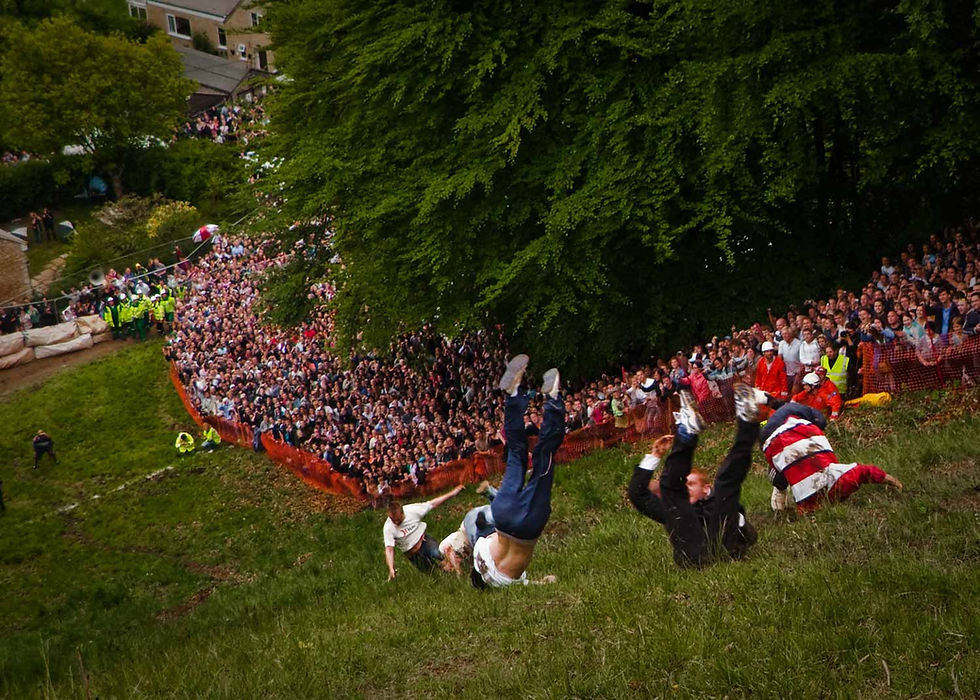
At Cooper’s Hill in Gloucestershire, competitors still throw themselves down a steep slope chasing a wheel of Double Gloucester cheese. The 2026 cheese rolling took place on 25 May, with competitors travelling from around the world to take part or watch. The event is chaotic, dangerous and strangely irresistible, partly because it looks like an ancient ritual that health and safety forgot to cancel.
Then there are the Cotswold Olimpick Games, held at Dover’s Hill near Chipping Campden. The event traces its origins back to 1612 and is best known today for shin-kicking, a contest in which competitors hold each other by the shoulders and attempt to kick one another’s shins until someone is forced to the ground. Straw padding is available, although that does not make the concept sound much wiser.
Ramsbottom has its own culinary battlefield in the World Black Pudding Throwing Championships, where competitors try to knock Yorkshire puddings from a high plinth by throwing black puddings at them. It is a sporting interpretation of the Wars of the Roses that nobody strictly needed, but somehow the country is better for having it.
Taken together, these events suggest that Britain has a remarkable ability to turn local food, landscape and folklore into competitive theatre. Cheese becomes a prize. Gravy becomes a wrestling mat. A bog becomes a race lane. A black pudding becomes a projectile. A shin becomes, unfortunately, a target.
Why We Love the Pointless
The easiest way to dismiss these events is to call them pointless. But that misses why they matter. Pointlessness is often part of the appeal.
So much of modern life is measured. Work must be productive. Hobbies become content. Exercise becomes data. Holidays become curated. Even leisure can feel as though it needs a purpose, an outcome or a photo that proves it was worth doing. Against that background, there is something liberating about a crowd gathering to watch someone dressed as a superhero disappear into a bog.
The point is not efficiency. The point is joy.
These events remind people that communities are not held together only by serious institutions. They are also held together by shared oddness. A village fair, a daft race, a messy contest, a local joke that somehow became annual tradition. These are the things that give a place texture. They become part of the story residents tell about where they live.
They also give people permission to be silly in public. That may sound minor, but it is not. Public silliness creates a kind of equality. For a few hours, adults can look foolish without shame, spectators can cheer for something absurd, and the normal rules of dignity are suspended.
In a country often accused of being awkward, reserved or emotionally buttoned-up, that release matters.
Local Pride in Fancy Dress
There is also a serious economic and cultural point underneath the costumes and mud. Odd events attract visitors. Visitors spend money. Local pubs, cafés, hotels, shops, charities and community groups benefit. Media coverage spreads the name of places that might otherwise be overlooked.
This is particularly important for smaller towns. A peculiar tradition can become a form of place marketing more powerful than a glossy slogan. People may not know much about Bacup, Llanwrtyd Wells, Cooper’s Hill or Ramsbottom, but they may know the gravy, the bog, the cheese or the pudding. That oddness becomes an invitation.
It also creates local pride. Not the grand, official kind, but the warmer sort that comes from being in on the joke. Residents may roll their eyes at the crowds, the parking, the noise and the mess, but many also understand that these events make their places distinctive. They turn ordinary locations into somewhere people travel to experience.
A town does not need to be perfect to be loved. Sometimes it just needs a story strange enough to belong to nobody else.
Tradition Does Not Have to Be Sensible
One reason these events survive is that tradition does not always need to make sense. In fact, making too much sense might ruin it.
Nobody would design cheese rolling from scratch as a modern public health initiative. Nobody would commission shin-kicking as a flagship sports programme. Nobody would look at a tub of gravy and produce a rational business plan for wrestling in it. Yet because these events already exist, they carry a charm that new inventions would struggle to fake.
Tradition often works because it has escaped ordinary logic. It continues because people remember it, laugh about it, volunteer for it, return to it and pass it on. The details may change, the crowds may grow and the social media coverage may become more intense, but the basic appeal remains the same.
The country needs some things that are not sleek, sensible or easily explained. It needs the annual reminders that not every tradition was designed by a committee, and not every local event has to look like a corporate festival.
Sometimes the best traditions are the ones that should probably never have started, but are now far too loved to stop.
The Serious Value of Being Ridiculous
There is a temptation to separate serious culture from silly culture, as though one matters and the other is just filler. But the silly things often tell us a great deal about who people are.
Gravy wrestling tells us about humour, charity and the northern talent for turning food into identity. Bog snorkelling tells us about rural invention and a Welsh town using its landscape in the most unexpected way possible. Cheese rolling tells us about risk, spectacle and the stubborn survival of old customs. Black pudding throwing tells us that local rivalry can be turned into something far more entertaining than bitterness.
These events may look like jokes, but they do real social work. They bring people out of their houses. They give volunteers something to build. They raise money. They attract visitors. They create photographs, memories and stories. They allow communities to be known for something that is not another chain shop, road scheme or funding problem.
That is why Britain’s strangest sports matter. They are not important because they are dignified. They are important because they are shared.
Long Live the Mud
The late-summer calendar gives Britain two perfect examples of this spirit. On 30 August, competitors will take to the bog in Llanwrtyd Wells. A day later, others will wrestle in gravy in Lancashire. Somewhere between those two events sits a surprisingly good summary of the national character: a little damp, deeply unserious, quietly charitable and much more competitive than anyone expected.
There are plenty of things in modern Britain that feel strained, divided or overcomplicated. That may be why these odd events feel so welcome. They do not solve anything, but they do offer a brief reminder that communities can still gather around something joyful, local and completely unnecessary.
Perhaps that is the real reason Britain keeps turning food, mud and madness into sport. Not because it makes sense, but because sense is not always what brings people together.
Sometimes all it takes is a bog, a wheel of cheese or a pool full of gravy.