

The Day Sweden Changed Sides: Why Britain Still Drives on the Left

The Morning a Whole Country Moved Over
At 5am on 3 September 1967, Sweden did something that sounds like the setup for a national practical joke. It changed sides of the road.
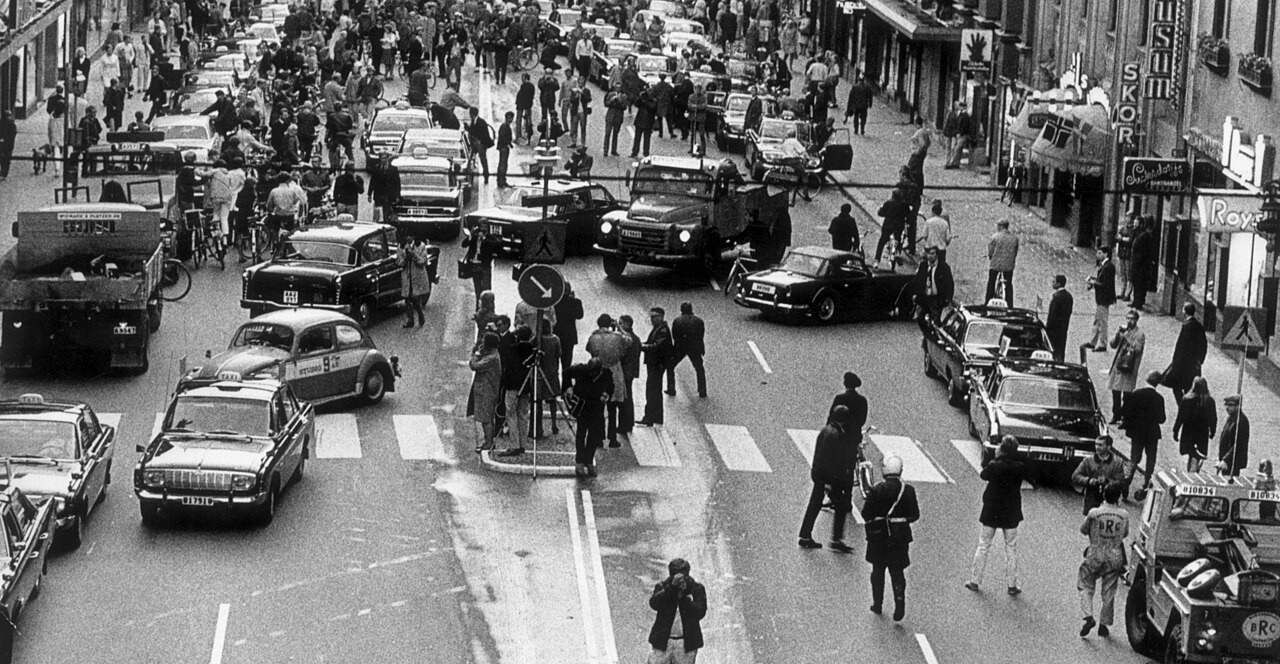
The event was known as Dagen H, short for Högertrafikomläggningen, or the right-hand traffic reorganisation. Until that morning, Sweden had driven on the left. After that morning, cars, buses, lorries and bicycles were expected to use the right. Not gradually. Not region by region. Not after a few trial weekends involving nervous volunteers and a lot of cones. The whole country switched at once.
It is one of those historical facts that feels both completely sensible and faintly ridiculous. Sensible, because most of Sweden’s neighbours drove on the right, and increasing car use made cross-border travel more common. Ridiculous, because changing the everyday behaviour of an entire nation at 5am requires a level of public cooperation that would make most governments break out in a cold sweat.
Imagine trying it in Britain. A minister appears on television and calmly explains that from Sunday morning everyone in Barnsley, Birmingham, Bristol and beyond will simply move over. Roundabouts will feel wrong. Bus doors will be on the wrong side. Road signs will have to move. Drivers will need to remember not to follow forty years of muscle memory into the path of a Volvo.
Sweden actually did it.
How Do You Move a Country?
The planning behind Dagen H was enormous. Swedish authorities created a special commission to handle the change, and the work was divided around roads, vehicles and people. The aim was not only to move traffic from one side to the other, but to keep the road network functioning and maintain road safety while doing it.
Road signs had to be replaced, moved or covered. New signs were put up in advance but hidden until the change took place. According to Sweden’s transport history collections, around 360,000 road signs were replaced, 130,000 reminder signs were installed, and about 8,000 buses had to be modified or replaced.
That is the part of the story that turns a funny fact into a logistical marvel. This was not just a case of telling everyone to remember “right, not left”. It meant rebuilding parts of the traffic environment so that ordinary people could perform an extraordinary change without crashing into one another.
During the night itself, most traffic was restricted. At 4:50am, vehicles that were allowed on the road stopped on the left, carefully moved across to the right, and then continued after 5am under the new system. In Stockholm, buses, cars and bicycles moved from the left to the right side of the streets at 5am.
There is something wonderfully neat about that image. A country pauses, shuffles sideways, and carries on.
Sweden Did Not Really Want To
One of the stranger parts of the story is that Sweden had already asked the public what it thought. In 1955, an advisory referendum was held on whether Sweden should switch to right-hand traffic. The public voted against the idea. Despite that, the Swedish parliament decided in 1963 that the change would happen in 1967.
That tells us something about the difference between what people prefer and what systems sometimes require. Most people do not enjoy being told that a familiar habit is about to be reorganised by the state. Driving is especially personal because it sits inside the body. People do not think carefully about every mirror glance, every turn, every lane position. They build habits and trust those habits to keep them safe.
Asking a country to change sides of the road is therefore not only a transport decision. It is a psychological one. It requires the public to unlearn something that feels automatic.
Sweden’s reason for changing was practical. Car ownership was rising in the 1950s and 1960s, more people were travelling between countries, and most of Sweden’s neighbours already drove on the right. There was another safety issue too: many Swedish cars already had the steering wheel on the left, which made overtaking harder and more dangerous when driving on the left.
So Sweden did what countries sometimes do. It made an unpopular change because the alternative looked increasingly awkward.
Why Britain Stayed Where It Was
Britain, of course, did not follow. We still drive on the left, along with countries including Ireland, Australia, New Zealand, Japan, India and others. For British drivers, the left side feels normal. For visitors from much of Europe, it feels like entering a mirror universe where roundabouts arrive from the wrong direction and hire cars become small tests of character.
There are many popular explanations for why Britain drives on the left. Some stories point back to horse riders keeping to the left so their right hand was free, or to older road customs that developed long before motor cars. These explanations are plausible, but they are difficult to pin down neatly. The more solid legal point is that the Highways Act 1835 formalised the practice of driving on the left. UK Parliament’s own history of road legislation states that the Act formalised left-side driving.
Once a system like that is built, it becomes hard to change. Roads, junctions, signs, bus stops, vehicles, driving lessons, road markings, public habits and everyday assumptions all grow around it. A country does not just drive on one side of the road. It builds an entire road culture around that side.
That is why the question is not simply whether Britain could switch. Technically, it could. Sweden proved that a country can change if it plans hard enough. The better question is whether the benefit would be worth the disruption.
So far, Britain has decided that it would not.
The Cost of Moving Over
There have been questions over the years about whether Britain should move into line with most of Europe and drive on the right. The answer has generally been no, partly because the practical case has never looked strong enough.
In 1994, a written answer in the House of Commons said the case for changing had been studied in 1969 and reviewed again in 1992. The review concluded that switching to the right would bring minimal economic benefits, could adversely affect road safety and would cost at least £2 billion.
That figure would be much higher today, but even the 1994 estimate makes the point. Changing sides would not be a matter of repainting a few arrows and telling everyone to be careful on Monday morning. It would mean reworking junctions, slip roads, signage, traffic lights, bus infrastructure, road markings, public information, training and vehicle fleets. It would also mean asking millions of drivers to abandon a lifetime of instinct.
Britain does plenty of strange things, but this may be one of the rare cases where staying strange is cheaper and safer than trying to become normal.
There is also the island factor. Sweden had land borders and ferry links into a wider right-driving road system. Britain is separated from continental Europe by the Channel. That does not remove the inconvenience, but it does reduce the pressure. A lorry or car entering Britain already has to cross by ferry or tunnel. The road system does not merge seamlessly at a border in quite the same way.
In short, Britain drives on the left because it always has, because the law formalised it, because the system was built around it, and because changing now would be an enormously expensive way to confuse everyone.
The Odd Comfort of Old Habits
There is a wider point here about national quirks. Some habits survive not because they are objectively better, but because changing them would create more trouble than keeping them. The left side of the road is one of those habits. It is not a daily political statement. It is not an act of rebellion against Europe. It is mostly just a system that works because everyone agrees to keep doing it.
That is the strange power of infrastructure. We often think of roads, signs and lanes as physical things, but they are also shared agreements. A white line only matters because everyone accepts what it means. A roundabout only works because drivers broadly understand the choreography. Driving on the left or right is a national agreement repeated millions of times a day.
When Sweden changed sides, it showed that even deeply embedded habits can be altered. But it also showed how much planning, communication and public discipline are needed to make such a change possible.
Most of the time, countries do not change systems like this because they have suddenly discovered the perfect answer. They change because the old system has become too inconvenient, too dangerous or too isolated from the world around it. In Sweden’s case, left-side driving increasingly looked like the odd one out. In Britain’s case, it still looks like an old oddity that works well enough to survive.
A Very British Non-Decision
There is something very British about the fact that we have looked at the idea of switching sides and essentially replied: “No, thank you. Far too much bother.”
That may not sound visionary, but it is not necessarily wrong. Not every old habit needs reform. Not every difference needs smoothing out. Sometimes the cost of making a country tidier on paper is much higher than the benefit in real life.
The Swedish example remains fascinating because it proves that national habits are not immovable. At 5am on 3 September 1967, a country changed a rule that millions of people used every day. It took years of planning, huge public information campaigns, thousands of signs, altered buses and a great deal of trust that everyone else would remember the same instruction at the same moment.
Britain stayed where it was.
That is probably just as well. We have enough trouble with potholes, smart motorways, bus lanes and people who still do not know how to indicate at roundabouts.
As “did you know?” facts go, Dagen H is one of the best. It is funny because it sounds impossible. It is serious because it actually happened. And it is useful because it reminds us that the things we treat as natural are often just old decisions that became normal.
Sweden changed sides in a morning.
Britain looked at the price, looked at the roads, looked at the drivers, and stayed firmly on the left.


